Origins of the neo-Grec (part 4)
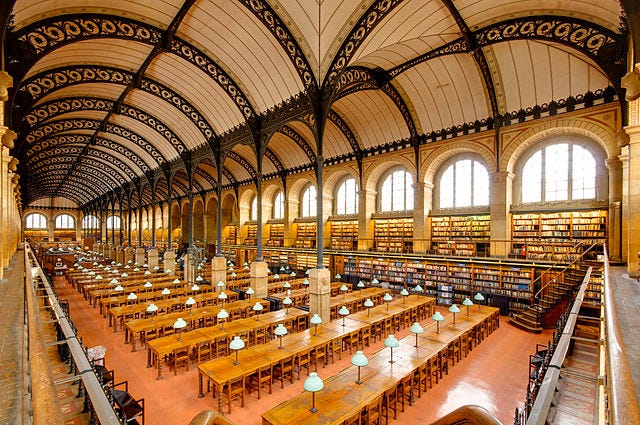
The American neo-Grec style was an adaptation of French architectural discourse from the 1840s. At this time, French architects revived an interest in Classical Greek design while simultaneously integrating new, modern, industrially-produced materials like steel. The work of Henri Labrouste, particularly the Bibliothèque Sainte-Geneviève, which uses simplified designs thoughtfully placed to emphasize building structure within a classical framework, is generally referred to as the primary example of the French neo-Grec. Labrouste’s use of slender steel columns connected by steel arches of decorative fretwork, demonstrated how a new industrial material could be integrated into a classically inspired design, without a loss of either beauty or ornamentation.
The return of Richard Morris Hunt — who was the first American to study at the École des Beaux-Arts in Paris — introduced contemporary French architectural theory, and thereby the neo-Grec, to the United States in the late 1850s. While in Paris, Hunt would have been surrounded by discussions of whether the néo-grec could successfully combine the rational building of Classical Greece with the romantic ideas of architecture in contemporary France. In setting up his practice, and his own atelier, in New York, Hunt shared this discourse and perspective through his designs and his teaching. Hunt’s work was widely covered in architectural publications and was influential in the contemporary design field.
His Tenth Street Studio Building, built in 1857, introduced a French-influenced “Graeco-Romantic” design that stressed rational and geometric facade organization. His more ornamental designs for the John Quincy Adams Ward Houses (1868–1869) were more typical of how the neo-Grec style was interpreted for row house architecture, with incised designs placed in areas of structural load and tension, around openings, and in bands and paneling along the facade. Such placement of decoration in those areas that carry a building’s weight was seen as an attempt to show honesty in architecture. According to architectural historian Sarah Bradford Landau “the New York architects and builders who followed Hunt’s lead picked up on only the unmolded lintels and stylized ornament,” and the contemporary interpretation resulted in a preference for “simplicity and modernity.”
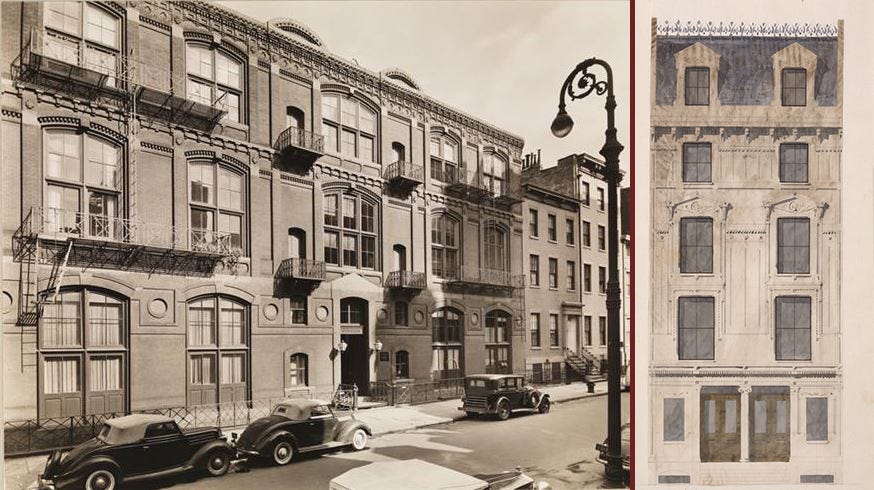
Considered modern due to the freshness of the designs themselves, the modernity of the style was reinforced by the use of new industrial processes that made this type of ornament easy to produce. The increased mechanization of stone cutting and tooling allowed for the broad adoption of mechanical planers and routers, which could be operated by relatively unskilled workers. With the nation still recovering from the loss of a generation to the Civil War, labor costs had skyrocketed and replacing highly skilled and expensive master carvers with lower paid wage laborers helped cut costs in the construction industry. The choice to actively integrate new technology also served to place neo-Grec designs in counterpoint to the seemingly fussy and old-fashioned details of the Italianate style. By the 1870s, the neo-Grec had become the style of choice for the row houses of New York City, offering delicate, decorative, and cutting-edge design delivered quickly and at a low cost.

For the other parts of this series see parts one, two, three, and five. For more images of the neo-Grec in the wild of our urban environment see my instagram (@knowing_neogrec). If you would like to connect professionally, please visit Reiter Preservation Consulting.